





First, let’s talk about your journey. How did you get into design? When did you know you were meant to be a creative?
Hello everyone! My story is that I took a long, circuitous path getting into design, but I’d have it no other way.
I started off by going to university for behavioural psychology and worked over six years in academic research before I even dipped a toe into the world of tech. Instead of following my original plan and going back to school for another degree, I was incredibly lucky to have the opportunity to join Google on an experimental new team. Remember that movie “The Internship” and those interview questions about how many golf balls would fit into a Prius? Yeah those. The team I joined was tasked with getting rid of those wacky question and creating a better and fairer, more predictive way of hiring.
You see, most people are overconfident in their ability to assess if someone is going to be a good hire. By nature humans are biased, and we rely on our “gut” to tell us whether or not we like someone. However, the factors that inform our intuition can sometimes be completely unrelated to whether or not someone will perform well at their actual job.
While building out this methodology, it became apparent that simply building a conceptual framework wasn’t incentivizing enough for busy interviewers to use — we needed to create an interactive tool that could help them easily utilize our framework in situ. And, as a scrappy, internal team, we didn’t have any design or engineering resources. So I ordered a huge stack of books, spent some time in the corners of the internet during my nights and weekends, and attempted to design the first version of Google’s first structured interviewing tool.
We ended up integrating these tools into Google’s hiring systems, and that opened the door for me to transition into a couple different design roles at Google. After a few years there, I thought it would be best to accelerate my growth by joining a startup rather than stay at a big company. And, by some stroke of luck, my portfolio got noticed by a hiring manager interested in my research background — I landed a dream job as one of the first product designers at Lyft!
What is your favourite design discipline and why? How did you find out it was your favourite? How can young designers find out?
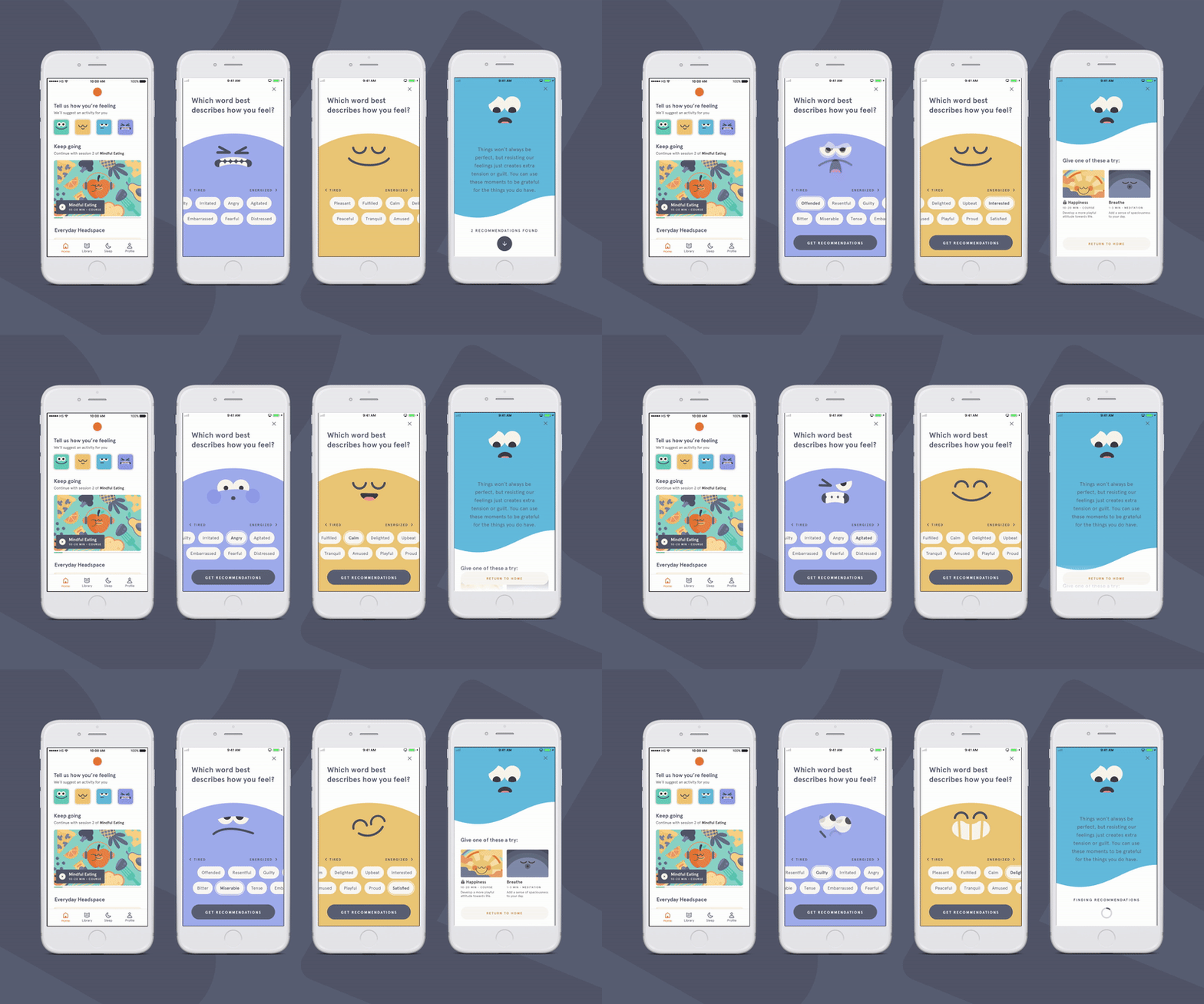
Over the years, I’ve gravitated towards interaction design and design research. Because I didn’t study traditional design, and my background is in behavioral science and research, I tend to lean on these skillsets when designing. For me, it’s exciting to think about the bigger effects of the product I’m working on out in the wild. For example, if someone starts using Lyft every day, does that mean they will eventually sell their car? Do they start using more public transport in conjunction with Lyft? Will they save money and discover new interactions? How does that impact their lives? How does that impact the community when that happens at scale? The country? The world?
I feel like it’s always best to let your own curiosity be the guiding compass. Rather than forcing yourself to build up the things you think you “should” be good at but aren’t naturally good at (for me this was visual design), it’s much more enjoyable to lean into the things that you naturally gravitate towards.
This is also the approach behind “Strengthsfinder” framework, which champions the idea of focusing on your strengths, rather than trying to build up your weaknesses. By focusing on your strengths, the end result is that you have at least one deep expertise that you’re good at and passionate about, rather than being just okay at everything. The caveat here is that if you’re really bad at something that’s required for design, you should probably become competent in that area.
Focus on your strengths, rather than building up your weaknesses.
Do you think young designers should try to learn many disciplines or focus on mastering a single one?
When thinking about generalists vs. experts, I like to think about “T-shaped” people. Similar to the Strengthsfinder framework, a T-shaped person has both a depth (the leg of the T) and breadth (the arms of the T).
The depth means that you have a deep expertise in one area, say it’s your passion, and the breadth means you also have a range of other skills that you’re pretty good at. When working on cross-functional teams, or hiring for my design teams, I’ve found that it’s really helpful if the team has a variety of expertises, so you can create complementary depths which beget natural mentorships.
This quote from by David Epstein’s new book Range really resonated with me, as I’m a generalist myself:
“Generalists often find their path late, and they juggle many interests rather than focusing on one. They’re also more creative, more agile, and able to make connections their more specialized peers can’t see.”
In his book Range, Epstein makes the argument that generalists, not specialists, are primed to excel. Beyond the practicality of this approach (imagine the skills you’ll need if the jobs of the future have not been invented yet), it reminds us of the value of exploring the entire world, not just one part of it.

What is your creative process? Do you think young designers should have a set of processes or go with the flow?
Process is kind of weird. If you’ve worked at a big company, it can be tedious; if you’ve worked at a tiny one, you’ve thirsted for more. I find myself leaning on processes for foundational things (decision making frameworks, identifying values, etc) that help me think through big ideas, and going freeform for everything else. Honestly, whatever works for you and your team is the best bet. Find a place where you can be free to pick and choose, and change your minds about what processes work for everyone in that moment.
Find a place where you can be free to pick and choose, and change your minds about what processes work for everyone.
How do you get inspired?
When I’m feeling stagnant or uninspired, I seek out adventures! Sometimes that means going off to a new country and wandering around a city. Sometimes that means getting back to nature and rock climbing or a picnic in a park with a book and friends. If I’m really feeling lucky, it means I get to hop on a motorcycle and ride — the most freeing feeling in the world.
Whatever your peak experiences are, find them and revisit frequently.
Do you think having a portfolio is important for young designers? What would your dream rookie designer portfolio be?
When you’re an emerging designer (and I use the word “emerging” because I know not all new designers are young), your best bet is to tell a compelling story of who you are. For some people, this could be a portfolio. For others, this could be something completely different.
Just because you have a fancy portfolio doesn’t mean you can work with cross-functional team to ship product, nor does it mean you can solve problems. And it certainly doesn’t mean you’re a great human to work with. Whatever you make to show your work, make sure it shows who you are too!
When I’m digging through piles of resumes and portfolios, I really love when someone goes out of their way to do something that really helps me understand who they are — something that captures what makes them special. Maybe it’s a passionate letter to the team. Maybe it’s a wacky cartoon. Maybe it’s casually coming by the office for coffee until everyone in the office knows your name. Who knows! Get creative 😜
When digging through piles of portfolios, I really love when someone goes out of their way to do something that really helps me understand who they are.
Do you have any favourite books/resources you would have loved to read when you were younger to help boost your creative career?
- ‘Universal Principles of Design’ (William Lidwell), for helping me understand that design is all around us
- ‘The Crossroads of Should and Must’ (Elle Luna), for giving me the courage to do all the things I secretly wanted all along.
- ‘The Shape of Design’ (Frank Chimero), for a thoughtful and wise look on the thing we do every day. Worth a read now, and then later in your career.
To wrap up, do you have a favourite quote? How is it relative to your creative career?
“If you only read the books that everyone else is reading, you can only think what everyone else is thinking.”
Haruki Murakami
Dance to the beat of your own drum! I like this quote because it reminds me to give permission to myself keep doing that.
Anything you want to promote or plug?
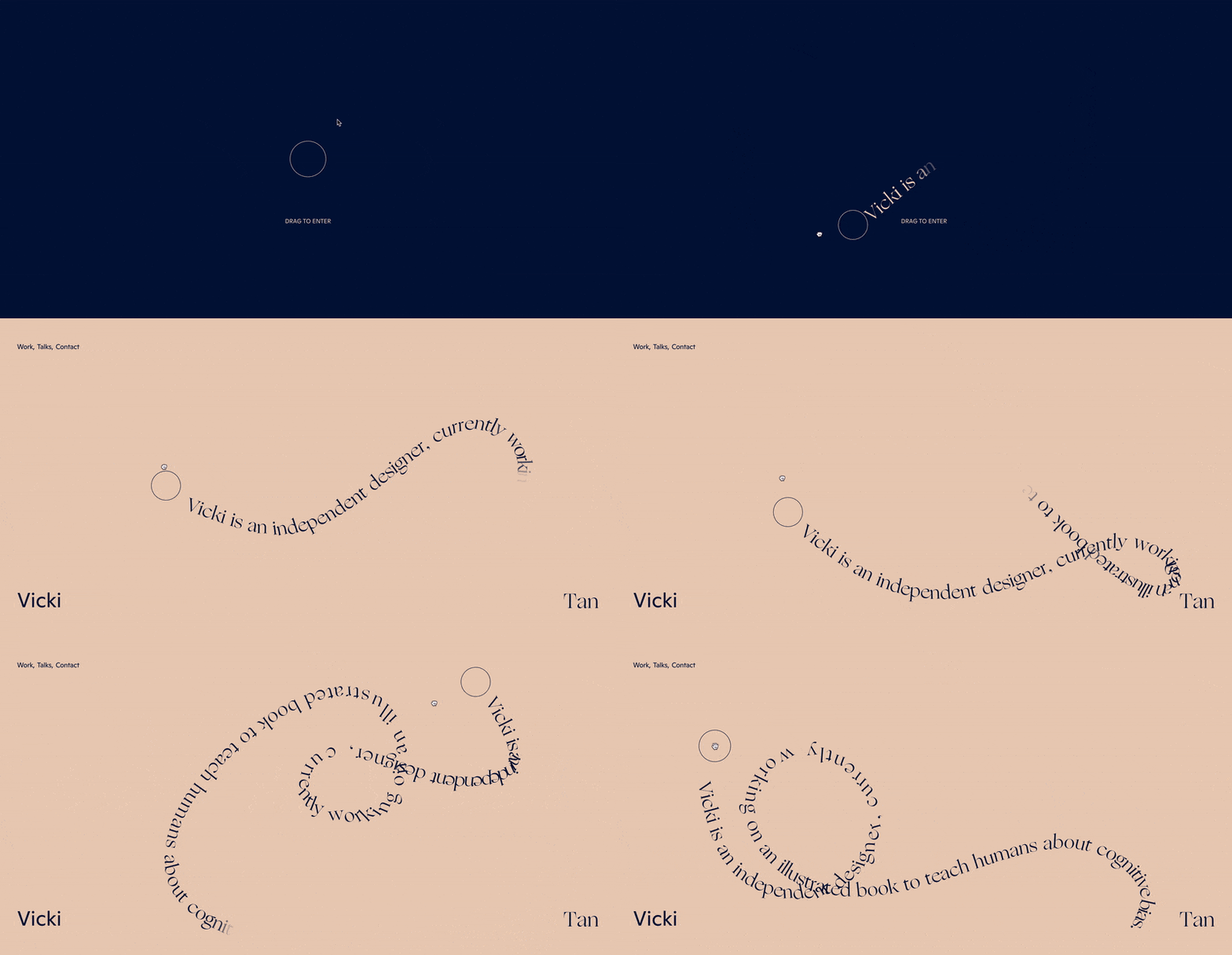
I’m working on an illustrated book about cognitive bias! Support my Patreon or follow me on Twitter for mostly nonsensical tweets.